
AI for small businesses: start with one taskAI cho doanh nghiệp nhỏ: bắt đầu từ một việc
Small firms rarely need an AI strategy deck. They need one repetitive task, a before and after measurement, and the patience to do it properly.Doanh nghiệp nhỏ hiếm khi cần một bộ slide chiến lược AI. Họ cần một đầu việc lặp lại, một phép đo trước và sau, và đủ kiên nhẫn để làm cho đến nơi.
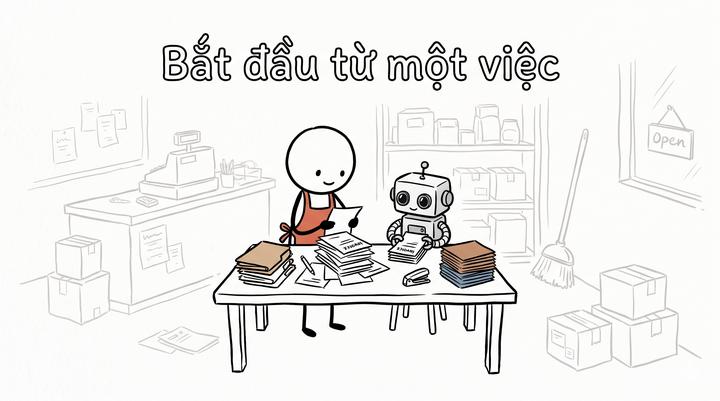
For years, research and development felt out of reach for small and mid-sized businesses: big teams, big budgets, long timelines. That logic is changing. When knowledge tools cost almost nothing to access, a ten-person company can work with the reach of a much larger one. Budget is no longer the main barrier. The way the work is organised is.
I often compare it to flooding in Ho Chi Minh City. The rain is only part of the story. The sea level is rising underneath every street, so the same rainfall floods more each year. AI behaves like that inside a business. It affects more than a task here and there. The water level is rising under the whole company, and the question is where to build the first dyke.
Small businesses have one advantage here that large ones lack: short distances. The owner often knows every process personally, can decide in a day and can see the result within a week. A large corporation needs committees, procurement and change management before a pilot starts. That advantage is wasted if the small firm tries to copy the large firm's approach, with a strategy document, a vendor selection and a company-wide rollout.
There is also a cost advantage that did not exist five years ago. The best general AI tools cost roughly the same per user for a ten-person company as for a multinational. For the first time, the small firm gets the same research assistant, drafting tool and analyst as its largest competitor. What it lacks is time to experiment and people to own the change, which is why the approach has to be narrow and disciplined.
The wrong measure
Large organisations show what not to do. The Straits Times reported that when NUS pushed AI usage and put it into performance indicators, staff saw more AI-made errors to fix, and some began "tokenmaxxing": running pointless prompts just to raise their numbers. Meta and Amazon reportedly dropped internal AI usage leaderboards for similar reasons.
The lesson is old. Goodhart's law says that when a measure becomes a target, it stops being a good measure. Counting prompts tells you people are using a tool. It says nothing about whether the work got better. A small firm should measure what the owner already cares about: how long a task takes, how often the output has to be corrected, how quickly a customer gets an answer, how much a process costs per month.
Start with one task
The four-week pilot is deliberately small. One task, one owner, one tool. The owner is a person who does the task today and will decide whether the new way is better, not a manager watching from outside. Four weeks is long enough to get past the first excitement and the first frustration, and short enough that nobody loses much if the pilot fails.
The before measurement is the step most often skipped, because it feels like delay. Without it, the pilot proves nothing. After four weeks everyone will have an opinion, and the opinions will reflect who liked the tool. With a simple record of how long the task took and how many errors it had in the two weeks before, the conversation becomes factual. Often the result is mixed: faster, but with new kinds of errors. That is still useful, because it tells you what to fix next.
Good first tasks are boring: reconciling invoices, summarising customer emails, drafting standard quotations, checking documents against a list. They happen every week, follow clear rules, and someone already knows what a good result looks like.
The chart places tasks by two judgments: how often they happen and how clear the rules are. Frequent tasks with clear rules are the place to start, because the savings repeat every week and errors are easy to spot. Frequent tasks with vague rules, like summarising customer emails, can still work, but a person should read the output before it drives a decision. Rare tasks with clear rules can wait. Rare and vague tasks, such as the annual strategy, should stay with people, perhaps with AI as a research assistant.
People are the part that decides whether the pilot sticks. Staff who do the task today may worry that a successful pilot means their job disappears. In a small company that worry spreads fast and quietly undermines the work: errors are not reported, the tool is blamed for problems it did not cause. The owner should say clearly, at the start, what the freed time will be used for. In most small firms there is no shortage of work that never gets done, such as following up with old customers, improving the website or cleaning up records.
After the first task
When the first pilot works, the temptation is to roll the tool out everywhere. A better step is to write down what was learned: what the tool did well, where it failed, how much checking it still needs, what had to change in the process around it. That page becomes the template for the second task. After three or four tasks, the company has something more valuable than a strategy deck: a small internal playbook based on its own data and its own people.
Data protection deserves attention from the first task. Customer emails, invoices and quotations contain personal and commercial data, and Vietnam's personal data law applies to small firms too. Before pasting real documents into a public tool, the owner should know where the data goes and whether the tool keeps it. For some tasks, a local or enterprise version is worth the extra cost. For others, removing names and account numbers before processing is enough.
Advisers and vendors will offer more. Some will propose a platform that covers sales, accounting and customer service at once, with an implementation timeline of six months. For a small firm that is usually the wrong first step. It is expensive, it changes many processes at the same time, and when results are disappointing it is impossible to say why. One task, measured, then the next, is slower to describe in a sales meeting and much faster to produce value.
One task done well teaches more than ten tools bought.
Nhiều năm qua, nghiên cứu và phát triển có vẻ nằm ngoài tầm với của doanh nghiệp nhỏ và vừa: cần đội lớn, ngân sách lớn, thời gian dài. Logic đó đang thay đổi. Khi công cụ tri thức gần như miễn phí, một công ty mười người có thể làm việc với tầm vóc của một công ty lớn hơn nhiều. Ngân sách không còn là rào cản chính. Cách tổ chức công việc mới là rào cản.
Tôi hay so sánh nó với chuyện ngập ở TP. Hồ Chí Minh. Mưa chỉ là một phần câu chuyện. Mực nước biển đang dâng lên dưới mọi con phố, nên cùng một lượng mưa mà năm sau ngập hơn năm trước. AI vận hành giống vậy bên trong doanh nghiệp. Nó tác động đến nhiều thứ hơn một vài đầu việc lẻ tẻ. Mực nước đang dâng dưới cả công ty, và câu hỏi là nên đắp con đê đầu tiên ở đâu.
Doanh nghiệp nhỏ có một lợi thế mà doanh nghiệp lớn không có: khoảng cách ngắn. Chủ doanh nghiệp thường nắm từng quy trình, quyết được trong một ngày và thấy kết quả trong một tuần. Tập đoàn lớn cần hội đồng, mua sắm và quản lý thay đổi trước khi một dự án thí điểm bắt đầu. Lợi thế đó sẽ bị phí nếu doanh nghiệp nhỏ bắt chước cách làm của doanh nghiệp lớn, với tài liệu chiến lược, lựa chọn nhà cung cấp và triển khai toàn công ty.
Còn có một lợi thế chi phí mà năm năm trước chưa có. Những công cụ AI đa năng tốt nhất có giá trên mỗi người dùng gần như nhau với công ty mười người và với tập đoàn đa quốc gia. Lần đầu tiên, doanh nghiệp nhỏ có cùng trợ lý nghiên cứu, công cụ soạn thảo và chuyên viên phân tích như đối thủ lớn nhất của mình. Thứ nó thiếu là thời gian để thử nghiệm và người đứng ra lo sự thay đổi, nên cách làm phải hẹp và có kỷ luật.
Thước đo sai
Các tổ chức lớn cho thấy điều không nên làm. Báo Straits Times đưa tin khi NUS đẩy mạnh dùng AI và đưa nó vào chỉ số đánh giá hiệu suất, nhân viên phải sửa nhiều lỗi do AI tạo ra hơn, và một số bắt đầu "tokenmaxxing": chạy những prompt vô nghĩa chỉ để tăng con số. Meta và Amazon được cho là đã bỏ bảng xếp hạng mức dùng AI nội bộ vì lý do tương tự.
Bài học này đã cũ. Định luật Goodhart nói khi một thước đo trở thành mục tiêu, nó không còn là thước đo tốt. Đếm số prompt cho biết mọi người đang dùng công cụ. Nó không nói gì về việc công việc có tốt lên không. Doanh nghiệp nhỏ nên đo những gì chủ doanh nghiệp vốn quan tâm: một việc mất bao lâu, đầu ra phải sửa thường xuyên đến mức nào, khách nhận được câu trả lời nhanh ra sao, một quy trình tốn bao nhiêu mỗi tháng.
Bắt đầu với một đầu việc
Đợt thí điểm bốn tuần được cố ý giữ nhỏ. Một đầu việc, một người phụ trách, một công cụ. Người phụ trách là người đang làm việc đó hằng ngày và sẽ quyết định cách mới có tốt hơn không, chứ không phải một người quản lý đứng ngoài quan sát. Bốn tuần đủ dài để qua giai đoạn hào hứng đầu tiên và bực bội đầu tiên, đủ ngắn để không ai mất nhiều nếu thí điểm thất bại.
Phép đo trước là bước hay bị bỏ qua nhất, vì nó có vẻ làm chậm việc. Thiếu nó, đợt thí điểm chẳng chứng minh được gì. Sau bốn tuần ai cũng có ý kiến, và ý kiến phản ánh ai thích công cụ. Có một ghi chép đơn giản về thời gian và số lỗi của đầu việc trong hai tuần trước đó, cuộc trao đổi trở nên dựa trên dữ kiện. Kết quả thường lẫn lộn: nhanh hơn, nhưng xuất hiện kiểu lỗi mới. Điều đó vẫn hữu ích, vì nó cho biết cần sửa gì tiếp theo.
Đầu việc đầu tiên tốt thường nhàm chán: đối chiếu hóa đơn, tóm tắt email khách hàng, soạn báo giá theo mẫu, kiểm tra hồ sơ theo danh sách. Chúng diễn ra hằng tuần, theo quy tắc rõ, và đã có người biết kết quả tốt trông như thế nào.
Biểu đồ xếp các đầu việc theo hai nhận định: tần suất xảy ra và độ rõ của quy tắc. Việc thường xuyên với quy tắc rõ là nơi bắt đầu, vì phần tiết kiệm lặp lại mỗi tuần và lỗi dễ phát hiện. Việc thường xuyên nhưng quy tắc mơ hồ, như tóm tắt email khách hàng, vẫn làm được, nhưng nên có người đọc kết quả trước khi nó dẫn tới quyết định. Việc hiếm với quy tắc rõ có thể để sau. Việc vừa hiếm vừa mơ hồ, như chiến lược năm, nên để con người làm, có thể dùng AI như trợ lý nghiên cứu.
Con người là phần quyết định đợt thí điểm có trụ lại được không. Nhân viên đang làm đầu việc đó có thể lo rằng thí điểm thành công nghĩa là mất việc. Ở công ty nhỏ, nỗi lo đó lan nhanh và lặng lẽ phá hỏng công việc: lỗi không được báo, công cụ bị đổ lỗi cho những vấn đề nó không gây ra. Chủ doanh nghiệp nên nói rõ ngay từ đầu thời gian được giải phóng sẽ dùng vào việc gì. Ở hầu hết doanh nghiệp nhỏ, chẳng bao giờ thiếu những việc chưa từng có thời gian làm, như chăm sóc lại khách hàng cũ, cải thiện website hay dọn dẹp hồ sơ.
Sau đầu việc đầu tiên
Khi đợt thí điểm đầu tiên thành công, cám dỗ là triển khai công cụ ở khắp nơi. Bước tốt hơn là ghi lại những gì đã học: công cụ làm tốt ở đâu, hỏng ở đâu, còn cần kiểm tra bao nhiêu, quy trình xung quanh phải thay đổi gì. Trang ghi chép đó thành khuôn mẫu cho đầu việc thứ hai. Sau ba bốn đầu việc, công ty có thứ giá trị hơn một bộ slide chiến lược: một cẩm nang nội bộ nhỏ dựa trên dữ liệu và con người của chính mình.
Bảo vệ dữ liệu cần được chú ý ngay từ đầu việc đầu tiên. Email khách hàng, hóa đơn và báo giá chứa dữ liệu cá nhân và dữ liệu thương mại, và luật bảo vệ dữ liệu cá nhân của Việt Nam áp dụng cả với doanh nghiệp nhỏ. Trước khi dán tài liệu thật vào một công cụ công cộng, chủ doanh nghiệp nên biết dữ liệu đi đâu và công cụ có lưu lại không. Với một số việc, phiên bản chạy nội bộ hoặc bản doanh nghiệp đáng với chi phí thêm. Với việc khác, xóa tên và số tài khoản trước khi xử lý là đủ.
Nhà tư vấn và nhà cung cấp sẽ đề nghị nhiều hơn. Có người sẽ chào một nền tảng bao trùm cả bán hàng, kế toán và chăm sóc khách hàng, với lộ trình triển khai sáu tháng. Với doanh nghiệp nhỏ, đó thường là bước đầu tiên sai. Nó đắt, thay đổi nhiều quy trình cùng lúc, và khi kết quả không như mong đợi thì không thể nói vì sao. Từng việc một, có đo lường, rồi đến việc tiếp theo, nghe kém ấn tượng hơn trong buổi chào hàng nhưng tạo ra giá trị nhanh hơn nhiều.
Một việc làm đến nơi dạy được nhiều hơn mười công cụ mua về.