
Agents, without the hype: when one is enoughAgent không thần thoại: khi nào một agent là đủ
Most businesses that think they need a swarm of agents need one well-built agent, a clean database and a clear job.Phần lớn doanh nghiệp nghĩ mình cần cả bầy agent thật ra chỉ cần một agent làm tốt, một cơ sở dữ liệu sạch và một công việc rõ ràng.
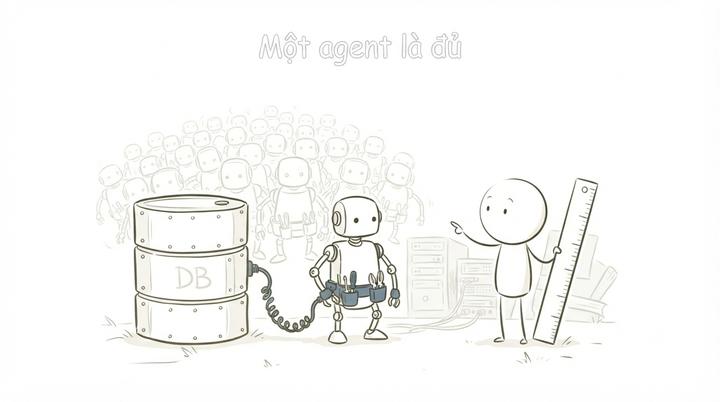
The word agent is now used for almost anything with a language model inside. Vendors call a chatbot an agent, a scheduled script an agent, a set of prompts glued together an agent. The confusion matters because it leads businesses to buy or build the wrong thing. To decide what to build, it helps to separate three levels.
Automation follows fixed rules and takes the same path every time. It is cheap, predictable and easy to audit, and it is still the right answer for a large share of business problems. An assistant answers questions and drafts things while a person decides and acts. An agent plans its own steps, uses tools, acts on real systems and checks its own result. Each level up gives the software more freedom and needs more control around it.
Four traits of a real agent
A real agent works toward a goal, an outcome, instead of producing a single reply. It uses tools that read and write real systems, such as a calendar, an ERP or a ticketing system. It keeps memory across steps, so it knows what it already tried. And it checks its own work before reporting that it is done.
The fourth trait is the one most demos skip and most production systems need. In a demo, the agent completes a task and the audience claps. In production, the agent completes a task, the customer's data turns out to have a missing field, and the agent reports success anyway. Self-checking means the agent compares its result against something it can verify: the record now exists in the database, the email was actually sent, the total matches the source. Without that, every output needs a human to check it, and most of the benefit disappears.
Three architectures
A workflow chains fixed steps with a model inside some of them. A hub and spoke design puts one agent in the middle, calling tools and smaller helpers. A true multi-agent system has several agents negotiating with each other. The last one gets the attention. In my experience almost all business cases are served by one of the first two.
The reason is cost of failure. Each agent in a multi-agent system can misunderstand the others, and the errors compound. When something goes wrong, finding out which agent made which decision and why is slow work. A single agent with good tools fails in fewer ways and is easier to debug. The multi-agent design makes sense for some research problems and very large systems. For a company that wants to automate purchase approvals, it is usually an expensive detour.
A useful test before choosing an architecture is to describe the process to a new employee on paper. If the description is a list of steps with a few decisions, a workflow will do. If it is one person who handles cases by consulting several systems, a single agent with tools matches it. Only if the description really involves several people with different goals negotiating, a buyer and a seller for example, does a multi-agent design start to earn its complexity. Most business processes, written down honestly, look like the first two.
The database is the source of truth
Agents forget, guess and sometimes contradict themselves. A system that relies on what the agent remembers will drift. A system where every step reads from and writes to one governed database can be audited, corrected and resumed.
This is the design principle I care about most, and it connects to the note on a single source of truth. If an agent decides to approve a purchase, the decision, the inputs and the reason should be written to the same database people use. Then a manager can see what happened, a colleague can pick up the case, and next year's model can replace this year's without losing history. The agent becomes a replaceable worker. The data layer is the memory of the organisation, and it should outlast every model.
Start small
The path I recommend has four steps. Pick one task that happens often and follows clear rules: matching invoices to purchase orders, classifying incoming requests, preparing a weekly status summary. Define what done means as a test you can run. Run the agent with a person reviewing every output for a few weeks. Widen its scope only when the results hold.
Defining done is the step most teams skip, because it feels like paperwork. It is the step that decides whether the project can ever leave the pilot phase. Without it, the team has no way to say the agent is good enough to run alone, so it never does, and the company ends up paying for both the agent and the person watching it.
Ownership also needs to be clear from the start. When an agent makes a mistake, someone in the company must be responsible for noticing it and fixing it, the same way a manager is responsible for a new employee's work. In practice that means naming a person for each agent, giving that person a simple view of what the agent did each day, and a way to stop it. It sounds bureaucratic. It is the difference between an agent the business trusts and one that everyone quietly works around.
For small and medium businesses in Vietnam, the practical starting point is often less glamorous than expected. Before any agent, the company needs its data in one place, with clear owners and consistent formats. Many of the projects I hear about stall at that stage. That is fine. Cleaning the data layer is worth doing for its own sake, and it is the foundation any later agent will stand on.
Build the smallest agent that can be trusted, then earn the right to make it bigger.
Từ agent giờ được dùng cho gần như mọi thứ có mô hình ngôn ngữ bên trong. Nhà cung cấp gọi chatbot là agent, một đoạn script chạy định kỳ là agent, vài prompt dán lại với nhau cũng là agent. Sự lẫn lộn này đáng bận tâm vì nó khiến doanh nghiệp mua hoặc xây nhầm thứ. Để quyết định nên làm gì, nên tách ra ba cấp độ.
Tự động hóa chạy theo quy tắc cố định và đi cùng một đường mỗi lần. Nó rẻ, dễ đoán, dễ kiểm toán, và vẫn là câu trả lời đúng cho phần lớn bài toán doanh nghiệp. Trợ lý trả lời câu hỏi và soạn nháp, còn con người quyết định và hành động. Agent tự lên kế hoạch các bước, dùng công cụ, tác động lên hệ thống thật và tự kiểm tra kết quả. Mỗi bậc lên cao cho phần mềm nhiều tự do hơn và đòi hỏi nhiều kiểm soát hơn xung quanh.
Bốn đặc điểm của một agent thật
Một agent thật làm việc hướng đến một mục tiêu, một kết quả, chứ không chỉ đưa ra một câu trả lời. Nó dùng công cụ đọc và ghi vào hệ thống thật, như lịch, ERP hay hệ thống phiếu hỗ trợ. Nó giữ bộ nhớ qua các bước để biết mình đã thử những gì. Và nó tự kiểm tra kết quả trước khi báo đã xong.
Đặc điểm thứ tư là thứ hầu hết bản demo bỏ qua và hầu hết hệ thống vận hành thật cần. Trong demo, agent hoàn thành việc và khán giả vỗ tay. Trong thực tế, agent hoàn thành việc, dữ liệu của khách hóa ra thiếu một trường, và agent vẫn báo thành công. Tự kiểm tra nghĩa là agent so kết quả với thứ nó xác minh được: bản ghi giờ đã có trong cơ sở dữ liệu, email thực sự đã gửi, tổng số khớp với nguồn. Thiếu bước này, mọi kết quả đều cần người kiểm tra lại, và phần lớn lợi ích biến mất.
Ba kiến trúc
Workflow nối các bước cố định, có mô hình nằm trong một vài bước. Thiết kế trục và nan đặt một agent ở giữa, gọi công cụ và các trợ thủ nhỏ hơn. Hệ đa agent thực sự có nhiều agent thương lượng với nhau. Loại cuối được chú ý nhiều nhất. Theo kinh nghiệm của tôi, gần như mọi bài toán doanh nghiệp đều được giải bằng một trong hai loại đầu.
Lý do nằm ở cái giá của thất bại. Mỗi agent trong hệ đa agent có thể hiểu sai các agent khác, và lỗi cộng dồn lên. Khi có sự cố, truy ra agent nào đưa ra quyết định nào và vì sao là việc chậm chạp. Một agent với công cụ tốt hỏng theo ít cách hơn và dễ gỡ lỗi hơn. Thiết kế đa agent hợp lý cho một số bài toán nghiên cứu và hệ thống rất lớn. Với một công ty muốn tự động duyệt đề nghị mua hàng, nó thường là đường vòng tốn kém.
Một phép thử hữu ích trước khi chọn kiến trúc là mô tả quy trình trên giấy như đang hướng dẫn một nhân viên mới. Nếu mô tả là một danh sách bước kèm vài điểm quyết định, workflow là đủ. Nếu đó là một người xử lý hồ sơ bằng cách tra cứu nhiều hệ thống, một agent có công cụ là vừa vặn. Chỉ khi mô tả thật sự có nhiều người với mục tiêu khác nhau thương lượng với nhau, ví dụ bên mua và bên bán, thiết kế đa agent mới bắt đầu xứng với độ phức tạp của nó. Phần lớn quy trình doanh nghiệp, viết ra thật lòng, trông giống hai loại đầu.
Cơ sở dữ liệu là nguồn sự thật
Agent hay quên, hay đoán, và đôi khi tự mâu thuẫn. Hệ thống dựa vào trí nhớ của agent sẽ trôi dần. Hệ thống mà mọi bước đều đọc từ và ghi vào một cơ sở dữ liệu được quản trị thì kiểm toán được, sửa được và chạy tiếp được.
Đây là nguyên tắc thiết kế tôi quan tâm nhất, và nó nối với bài về nguồn sự thật duy nhất. Nếu agent quyết định duyệt một đề nghị mua hàng, quyết định đó, dữ liệu đầu vào và lý do phải được ghi vào cùng cơ sở dữ liệu mà con người dùng. Khi đó người quản lý thấy được chuyện gì đã xảy ra, đồng nghiệp có thể tiếp nhận hồ sơ, và mô hình năm sau thay được mô hình năm nay mà không mất lịch sử. Agent trở thành một người làm thay được. Lớp dữ liệu là trí nhớ của tổ chức, và nó phải sống lâu hơn mọi mô hình.
Bắt đầu nhỏ
Con đường tôi khuyên có bốn bước. Chọn một việc xảy ra thường xuyên và theo quy tắc rõ: đối chiếu hóa đơn với đơn đặt hàng, phân loại yêu cầu gửi đến, chuẩn bị bản tóm tắt tình hình hằng tuần. Định nghĩa thế nào là xong bằng một phép kiểm tra chạy được. Cho agent chạy với một người xem lại mọi kết quả trong vài tuần. Chỉ mở rộng phạm vi khi kết quả ổn định.
Định nghĩa thế nào là xong là bước hầu hết các đội bỏ qua, vì nó có vẻ như thủ tục giấy tờ. Đó lại là bước quyết định dự án có bao giờ ra khỏi giai đoạn thí điểm hay không. Thiếu nó, đội không có cách nào nói agent đã đủ tốt để tự chạy, nên nó không bao giờ tự chạy, và công ty rốt cuộc trả tiền cho cả agent lẫn người ngồi canh nó.
Trách nhiệm cũng phải rõ từ đầu. Khi agent mắc lỗi, phải có một người trong công ty chịu trách nhiệm phát hiện và sửa, giống như người quản lý chịu trách nhiệm cho công việc của một nhân viên mới. Trên thực tế, nghĩa là mỗi agent có một người phụ trách được chỉ định, người đó có một màn hình đơn giản để xem agent đã làm gì mỗi ngày, và có cách để dừng nó lại. Nghe có vẻ quan liêu. Nhưng đó là khác biệt giữa một agent doanh nghiệp tin dùng và một agent mà mọi người lặng lẽ làm vòng qua.
Với doanh nghiệp nhỏ và vừa ở Việt Nam, điểm xuất phát thực tế thường kém hào nhoáng hơn mong đợi. Trước khi có agent nào, công ty cần dữ liệu nằm một chỗ, có người chịu trách nhiệm rõ ràng và định dạng thống nhất. Nhiều dự án tôi nghe kể dừng lại ở chính giai đoạn này. Điều đó không sao. Làm sạch lớp dữ liệu đáng làm vì chính nó, và đó là nền móng mà mọi agent sau này sẽ đứng lên.
Xây agent nhỏ nhất có thể tin được, rồi mới giành quyền làm nó lớn hơn.